
Power With the People
What a School Committee in Quincy Reveals About the America We Forgot

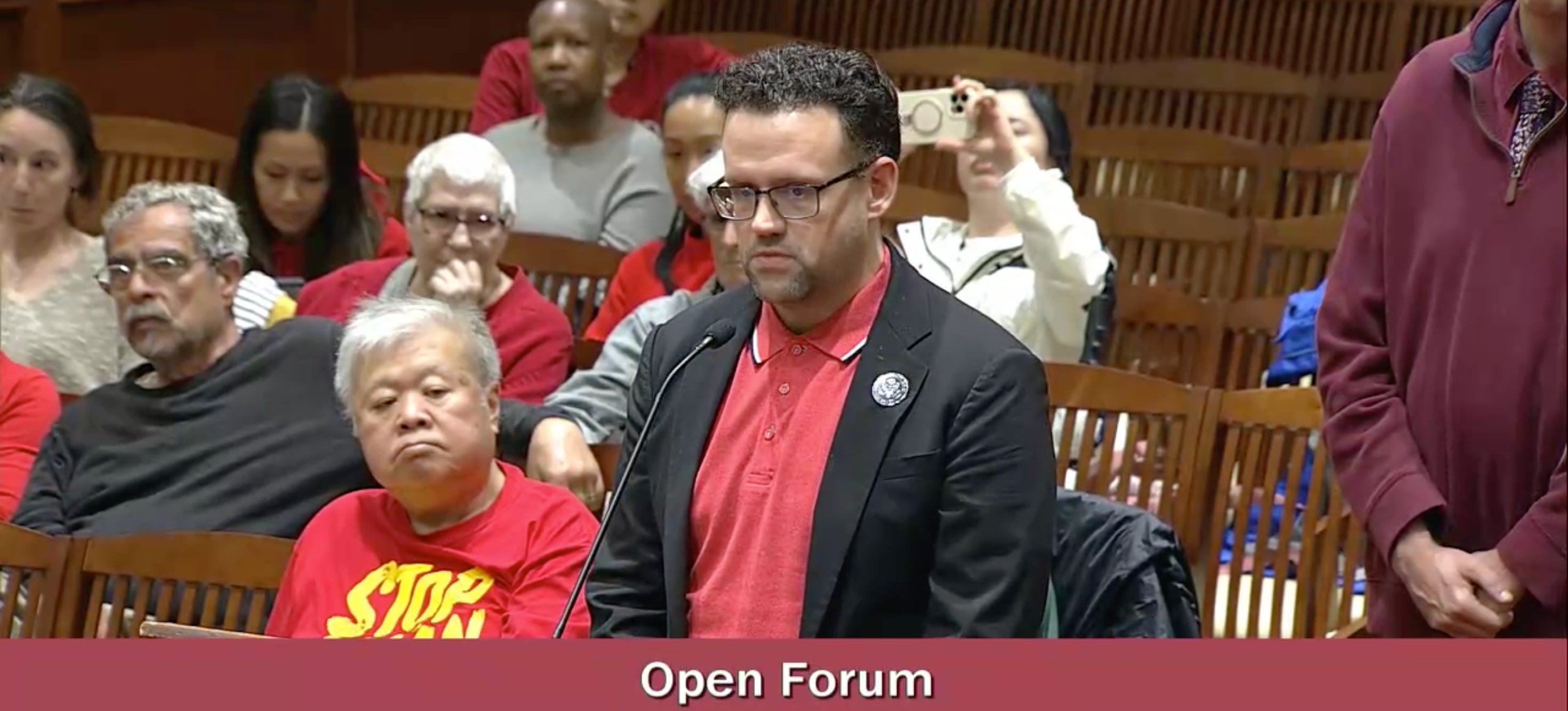
The rooms that matter most don’t have nameplates. Russ Wilcox speaking in support of LNY.
Lunar New Year is one the most widely celebrated holiday on Earth. More than two billion people observe it. It marks the beginning of the lunar calendar, a tradition older than every Western institution that has ever existed. Older than the Roman Senate. Older than Parliament. Older than the Constitution. Families gather. They clean their homes to sweep away misfortune. They share meals that carry meaning accumulated across millennia. Red envelopes. Lanterns. The color red itself, which in Chinese tradition wards off evil and signals renewal.
In Quincy, Massachusetts, forty percent of the students at North Quincy High School celebrate it. Last Lunar New Year, half the school stayed home. The school ran anyway.
Their families have been asking for three years to have the holiday recognized on the school calendar. Three years of subcommittees. Threshold votes. Legal opinions. And most recently, two more weeks for legal review.
Christmas has never required legal review. Good Friday did not need a subcommittee.
Five thousand years ago, a man named Da Yu faced a flood that was destroying China. His father tried to dam the water, to block it with walls. He failed. Da Yu succeeded by doing the opposite. He channeled the water. He built infrastructure that worked with the force rather than against it. And the authority he earned from that engineering became the legitimacy to found a dynasty.
Every Chinese schoolchild knows this story. It is the founding myth of Chinese governance. Build the channels. Control the flow. Earn the mandate to govern from above.
China still governs this way. Its 15th Five Year Plan, passed this March alongside a new Planning Law, converts the Party’s propositions into legal obligations through a single architecture. Its AI strategy embeds governance into infrastructure at every level. The channels are digital now, but the logic is Da Yu’s. Build from above. Channel the force. Earn legitimacy through engineering.
Last week, the Supreme Court gutted a key provision of the Voting Rights Act in Louisiana v. Callais. A 6-3 decision. Justice Alito, writing for the majority, insisted the court had “not overruled” its own precedents. Justice Kagan, in dissent, called it “the latest chapter in the majority’s now-completed demolition of the Voting Rights Act.” Sixty years of protection, reinterpreted into irrelevance.
And the American response, from policymakers and pundits alike, was to look upward. To Congress. To the courts. To the federal government. To the channels built from above.
That is not the American answer. It never was.
When Alexis de Tocqueville came to America in 1831, he did not find Da Yu. He did not find channels built from above. He found something that had no equivalent in China, in Europe, or anywhere else he had looked.
He found the township.
Citizens arguing about roads. Budgets. Fences. Schools. Local disputes so small they would embarrass a parliament. And he understood that the smallness was the point. Americans did not wait for a dynasty to channel the flood. They built their own channels, from the ground up, one town meeting at a time. The act of participation was itself the education. Citizens became citizens not by receiving governance but by doing it.
This was not the Federalist America of Hamilton and Madison, the America of constitutional architecture and federal design. This was something older and stranger. This was the America that existed before the Constitution caught up with it. Town meetings in New England preceded the Continental Congress. Local self-governance was not granted by the founding documents. The founding documents recognized what already existed.
Tocqueville saw it and he saw what made it different from everything else in the world. Da Yu’s China built legitimacy by engineering from above. Tocqueville’s America built legitimacy by participating from below. Both worked. Both produced stable civilizations. But they ran on opposite principles. One said: the people need channels built for them. The other said: the people build the channels themselves.
That is what America has forgotten.
Across this country, the rooms are empty.
School board meetings that draw three people. City councils that govern without witnesses. Town halls where the only audience is the cable access camera. Voter turnout in local elections that barely cracks double digits. The architecture Tocqueville marveled at still exists. The people have left.
This is not apathy. It is rational calculation. A March 2026 KFF Tracking Poll found that a third of American adults had used AI chatbots for health information in the past year. Significant numbers cited the inability to get an appointment or afford care as a major reason they turned to a machine instead of a doctor. The patient did not abandon the institution. The patient calculated that the information asymmetry justifying the institution had collapsed. The building still stands. The reason to enter it does not.
The same dissolution is running through everything. Chegg, the company built on the assumption that students needed an intermediary to access academic knowledge, lost 99.4% of its stock value. The Big Four consulting firms cut graduate hiring by 44%. In law, over 700 documented cases of AI hallucination in legal filings and more than 300 judicial standing orders attempting to manage the chaos. The professionals are not scrambling because AI replaced them. They are scrambling because AI dissolved the information monopoly that justified their role.
I call this the Last Harvest. The inverse of the agricultural revolution. Eight thousand years ago, humans began building the institutional infrastructure that allowed strangers to coordinate: granaries, tax systems, written law, the structures that became everything we now recognize as civilization. AI is dissolving those structures not by destroying them but by giving individuals the capabilities that used to require them.
China sees this happening and responds with Da Yu’s logic: tighten the channels, embed AI into governance from the top, ensure the infrastructure remains under central control. That is a coherent response. It is not America’s response.
America’s response has been to look upward. Federal regulation. Congressional hearings. Executive orders. National strategies. Every instinct in Washington says: build the channels from above. But America was never built from above. The moment America starts governing AI the way China does, it has already conceded the argument. It is playing Da Yu’s game on Da Yu’s terms with 250 years less practice.
The American answer was always the township.
In Quincy, on a weeknight, the room was full.
Families who have been showing up for three years. Families who still believe the process works. Who still believe that if you organize, bring data, follow the rules, speak during public comment, and demonstrate civic commitment year after year, the institution will eventually respond.
That belief is the rarest resource in American democracy right now. It is Tocqueville’s thesis, alive, in a room with folding chairs, in a city named after a president who fought for the right to petition.
The United States has tens of thousands of local governments. School boards, zoning commissions, water districts, town meetings. Every week, citizens sit in folding chairs and make decisions about their communities. No national plan. No Five Year Plan. Just people and budgets and arguments. China has nothing like this. No other nation on Earth has anything like this. Tens of thousands of points where governance actually touches people. That is not an inefficiency. That is the infrastructure Tocqueville said democracy requires to survive.
And here is what no one in Washington is talking about.
AI does not have to dissolve the township. AI can rebuild it.
Can a citizen use AI to read the budget their town manager wrote? To understand the zoning variance their neighbor filed? To see the pattern across three school board meetings that nobody else noticed? To translate a public hearing into the language their grandmother speaks? To surface a $285,000 mayoral pay raise buried in municipal records? To discover that ten-foot statues were commissioned for a public building without public input?
If they can, that is not the American weakness. That is the American answer. Not AI governed from Washington. AI governed from the folding chairs. Thousands of local governments, each one empowered by technology to do what Tocqueville saw Americans doing in 1831: govern themselves.
China’s answer to AI is Da Yu. Build the channels from above. America’s answer to AI should be Tocqueville. Build the channels from below. Empower the township. Trust the citizens who show up.
But the township only works if the institutions honor the people who fill it.
Tocqueville saw the threat alongside the promise. He called it soft despotism. An administrative power so gentle and procedural that the people subject to it never quite feel themselves being denied. No one says no. The system says not yet. It says subcommittee. It says legal review. It says come back next year with more data. The Supreme Court does not say it is demolishing the Voting Rights Act. It says it has not overruled its precedents. The school committee does not say no to Lunar New Year. It says two more weeks.
The mechanism is the same in Washington and in Quincy. Deny without saying no. Delay until the people stop coming. Reinterpret until the protection is gone but the language remains. Tocqueville warned that this is how democracies die. Not in revolution. In exhaustion. The chairs empty one meeting at a time.
And once the chairs empty, AI will not fill them. A citizen who reads the budget on their phone is more informed. A citizen who reads the budget in a room full of neighbors is more powerful. Information is individual. Governance is collective. AI can give you the diagnosis. It cannot give you the experience of standing next to someone who shares your fight and looking at the people in charge and saying: we are here.
That is what governance is. Not information. Recognition. The families in Quincy were not there because they lacked data. They had the data. They had the enrollment numbers. They had the evidence. They were there because recognition is not an information problem. It is a governance problem. And governance happens when people look each other in the eye.
That is what the Supreme Court does not understand about the Voting Rights Act. That is what the school committee does not understand about Lunar New Year. The law is not just a protection. The holiday is not just a day off. They are acts of recognition. They say: you are part of this. You count. You are seen. When the court guts the law or the committee delays the holiday, the message is the same. You showed up. It was not enough.
The Last Harvest is coming for every institution. The conditions that made hospitals, schools, courts, and governments necessary are dissolving faster than any of them are adapting. The Supreme Court just accelerated the dissolution by telling millions of Americans that sixty years of protection can be reinterpreted away in a single opinion. Every institution that responds to civic participation with delay, reinterpretation, and procedural exhaustion is making the same bet: that the people will stop coming.
China is betting on Da Yu. Build the channels. Control the flow. Keep the people inside the infrastructure the state designs.
America should be betting on Tocqueville. Trust the township. Empower the citizen. Use AI not to replace the folding chairs but to fill them. Give people the tools to see what their government is doing, to understand it, to challenge it, and to show up in the room where it happens with the knowledge they need to be heard.
That is the America Tocqueville found. Not the America of federal power and constitutional architecture. The America of town meetings and local arguments and citizens who believed that showing up was the whole point.
Quincy still has that America. Families in red shirts proved it. Three years of patience. Three years of process. Three years of showing up when every procedural signal said stop.
The question is not whether Lunar New Year goes on the calendar. Districts across Massachusetts have done it. There is no legal barrier.
The question is whether America remembers what it has. Tens of thousands of local governments. Tens of thousands of rooms with folding chairs. The greatest self-governance infrastructure ever built. And a generation of technology that could make it more powerful than Tocqueville ever imagined, if we use it to empower the people in the chairs instead of replacing them.
Da Yu built the channels. Tocqueville found the township.
The room was full. That is Quincy’s strength. That is America’s strength. The only question is whether the people in charge know what they have, or whether they will keep answering civic participation with two more weeks until the chairs are empty and the democracy is gone.
Russ Wilcox is a Quincy resident and Chair of the Policy Committee for the American Society for AI. He advises on US-China technology policy at the federal and international level and has been published in The Diplomat and the Jamestown Foundation’s China Brief.
The Supreme Court understood its job perfectly well. It was asked whether drawing districts by race violates the 14th amendment. It concluded, not unreasonably, that it did, and in the process reverted the VRA to something closer to its original form from before Congress's 1982 amendment. That the previous precedent had stood for long years and that it was not outright overturned is no absolute defense. If it were, then Brown, which narrowed Plessy, would have been wrongly decided. If the people believe that districts drawn by race should be permissible, then they should, using the very methods you highlight in this piece, elect representatives who will push for a constitutional amendment.
I wonder what the current GPA is in Quincy schools in general and what is the High school scholastic curriculum ? I will probably be able to AI the questions. Great read Russ.